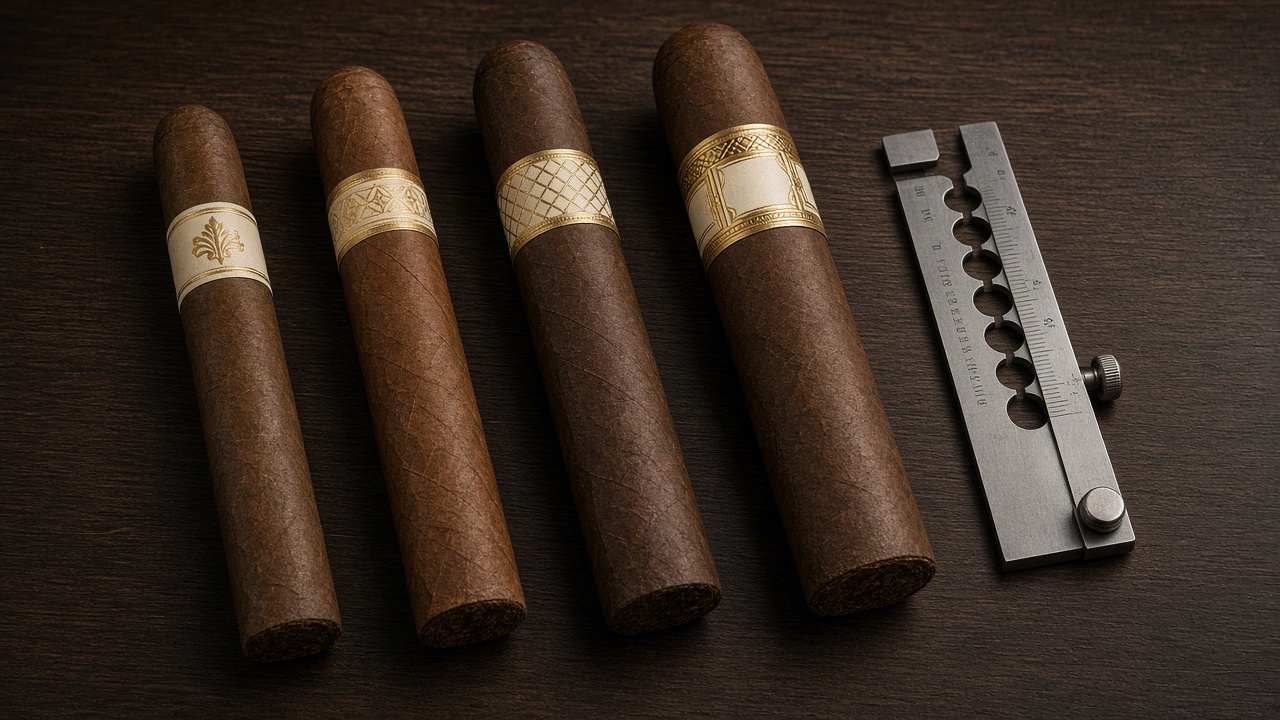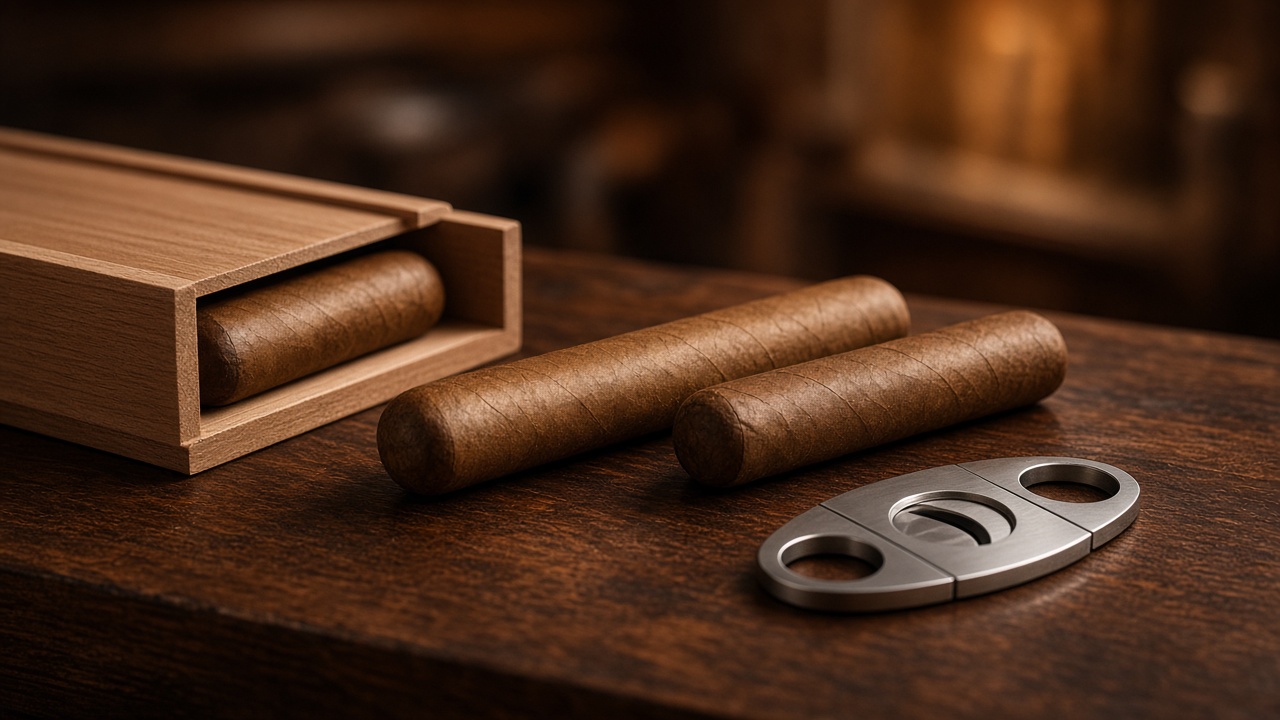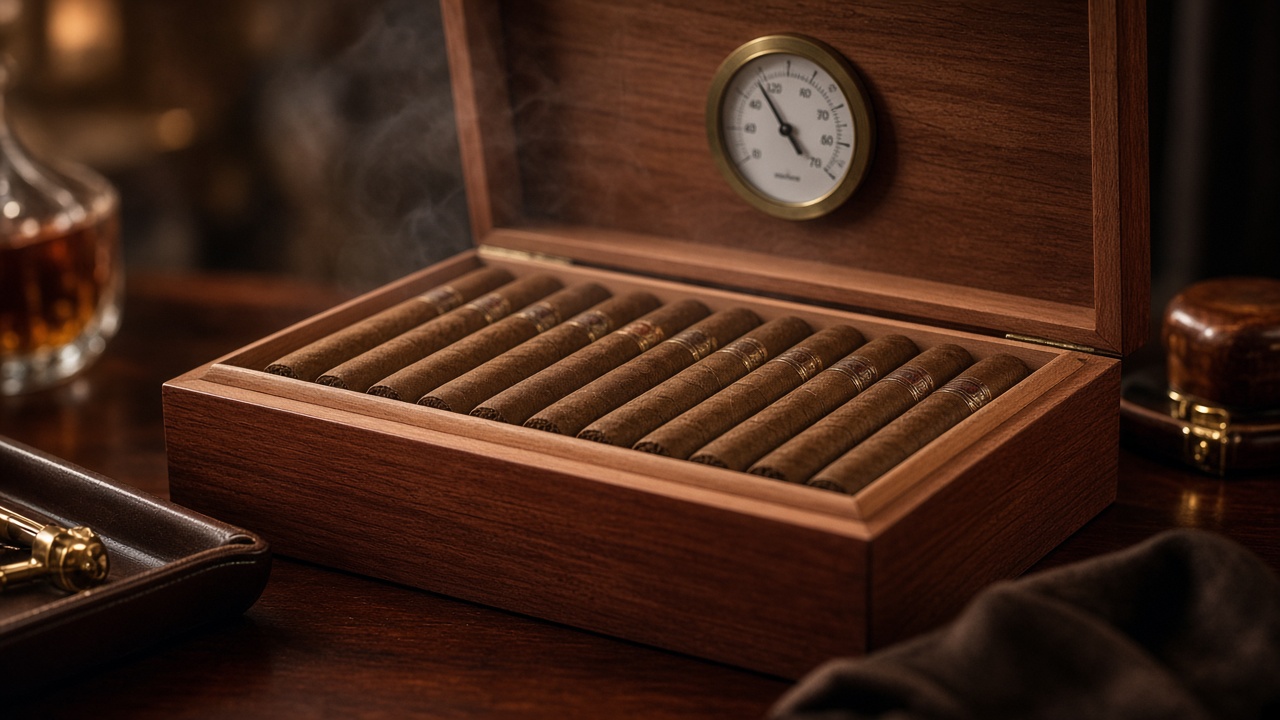
Storage decides more than the display case. Correct humidity protects leaf oils, even burn, and flavor for weeks and months. Wrong humidity cracks wrappers or invites mold. Below is a working home-humidor plan, tied to the Royal Smoke catalog and climate accessories.
Targets: about 65–70% RH and 18–21°C
Most premium cigars live well near 65–70% relative humidity with stable room temperature and no sharp swings. Above roughly 72–75% mold risk rises. Below about 60% wrappers turn brittle, burn races, and flavor flattens.
Do not chase a perfect number every minute. Stability wins: 67% for three steady weeks beats daily swings from 58% to 74%.
Humidor types: wood, acrylic, cabinet
Classic wooden humidor
Spanish cedar helps buffer moisture and adds a light aroma. Before the first load, season the box: bring the humidity inside the empty humidor up to working level, and only then place cigars in it. Cheap “souvenir” boxes without a proper seal often feed the hygrometer false readings.
Acrylic and travel humidors
Clear boxes with Boveda or other two-way packs are ideal for 5–25 cigars. They stabilize faster and are easier to maintain — a strong start while you build a selection from the cigar catalog.
Humidity regulators
Two-way packs (for example 65% or 69%) are safer than uncontrolled sponges with distilled water: less overshoot risk. Replace packs on the maker’s schedule or when they harden. Calibrate your hygrometer — a pretty number on a cheap dial guarantees nothing.
How to place cigars inside
- do not pack the box to the lid — air needs to move;
- remove cellophane only if you will smoke soon and understand the box climate;
- let new arrivals rest a few days after insulated shipping;
- isolate very aromatic profiles if you worry about scent transfer.
What never to do
- Fridge or freezer — condensation and food odors.
- Direct sun on the box.
- Radiator, heater, summer windowsill.
- “Make it wetter” with an open wet sponge and no control.
- Ignoring mold smell: fuzzy white growth on the wrapper seam means isolate immediately.
Short stock without a full humidor
For an evening smoke, a sealed bag with a small pack can last a few days. For weeks and months you need stable volume. For shipping across Ukraine we pack with climate in mind — details on delivery and payment.
Seasonal tips for Ukraine
Winter heating dries air: check the humidor more often. Summer heat raises vapor pressure — keep the box off sunny glass. If you leave for 2–3 weeks, refresh packs and store the box in shade.
When a cigar is “ready”
After purchase, let the leaf acclimate. A sharp jump from a dry courier case into a very wet box can mute aroma temporarily. After 3–7 days in a stable climate the profile usually opens more evenly — that is when you should judge a new catalog stick.
Calibrating a hygrometer in practice
Place the hygrometer in a sealed bag with a salt packet or a calibration sachet, following the manufacturer’s instructions. After a few hours compare the reading and set the offset. Without this you “treat” the box for problems that do not exist: you add moisture when it is already damp, or the other way round.
Digital instruments are more convenient than analog dials but also lie without calibration. Check once a season or after a drop or a battery change. Log the readings once a week — that way you see a trend, not a one-off spike after opening the lid.
Stock rotation and “rest” after delivery
It is better not to smoke new cigars on the day they arrive if they traveled through a changing climate. Give them 3–7 days in a stable humidor. If you buy several identical vitolas, open them gradually: that way you will feel how the profile opens after acclimation, and you will not spend the whole pack “on the courier’s temperature”.
Once a month, inspect the wrappers for cracks and suspicious bloom. A light crystalline bloom (oils) is not mold; a fuzzy white or green growth means isolate the cigar and ask for advice. Never put an affected cigar back with the healthy ones.
Home scenario: from 5 to 50 cigars
Up to 10–15 sticks, a quality acrylic digi-box is enough. At 25–50 it is worth thinking about a cedar box or a small cabinet with two regulators. Do not buy a giant safe “to grow into” if you are not ready to maintain it: a large volume takes longer to stabilize and drifts more easily when opened rarely.
Keep a separate small travel kit for trips so you do not open the main humidor every time. It reduces humidity swings at home and protects your main stock.
Signals that the climate slipped
A tight, “dry” draw, seam cracks, and fast extinguishing are signs of dryness. A soft sticky wrapper, a heavy stale smell in the box, and a heavy burn are signs of excess moisture. React gradually: move the regulator to the neighboring value (for example, from 69% to 65%) instead of shock-drying on a radiator.
If you go on vacation, leave the box in shade, refresh the packs, and do not open it “for goodbye” without need. After you return, give it a day to stabilize before judging the taste of a new catalog item. If you keep cigars for gifts, write the date you shelved them — that makes it easier to tell which stock has already “rested” and which is still acclimating after delivery from the showroom or warehouse.
Why stability matters more than the “perfect” number
A cigar is a living product with oils and a porous structure. It responds slowly to climate, so humidity jumps stress the wrapper. It is better to hold 66–68% for weeks than to chase 72% after an “emergency” wet sponge and fall to 60% the next day. A stable microclimate preserves an even burn, a predictable draw, and a cleaner finish — exactly what you pay for in the premium segment of the Royal Smoke catalog.